Revise GCSE Physics with us


Why Choose Our GCSE Science Revision Course?

Experienced Tutors

We started out in 1997 offering predominantly science revision, hence the name: Oxford Science Studies. For the vast majority of GCSE students science is compulsory.

Most schools offer students a choice of dual award, where Biology, Chemistry and Physics combine to count as two GCSEs; or a triple award, where the three sciences count as three separate GCSEs. Sometimes the triple award is referred to as single science – i.e. each science is a separate GCSE. Just to confuse things further AQA helpfully called their dual award offering “Trilogy” – which is frankly a baffling choice of name.

All our science tutors will be familiar with all the various distinctions and will pitch their sessions as appropriate to, for example, 2nd year higher level triple award Physics, 1st year foundation dual award or whatever.

Roughly 1 million students sit GCSE Physics in one form or another each year.

We currently have 80 tutors offering this subject, many have decades of experience.

Exam Board and Level Specific Student-led Tutorials

Like all our courses our GCSE Physics revision courses are bespoke and exam board and level  specific as appropriate. All our exam-based courses are student-led – the student(s) in the class determine what is covered during the course. See our Student-led Revision Courses page for how this works in practice.

We cover all GCSE exam boards and differentiate between dual and triple award, first and second year of GCSE, as well as higher and foundation level exams.

For our bigger courses the physics GCSE often will be taught in small groups, typically 2-4 students, with a maximum of 6.

Although the content of all our courses is student-led the tutors will also have a list of topics that they know students often get wrong or struggle with.

From a tutor and student point of view the student-led approach is a huge advantage. Focusing on problem areas is the most effective use of the limited time on a revision course.

Why not just revise at home?

The vast majority of revision has to be done at home and for most GCSE students their GCSEs will be their first set of public exams. Hence, it will potentially be the first time that they have had to revise seriously. In a perfect universe they will have revised many times before, but, obviously, this is a major step up for many students.

In the case of GCSEs we are here to help students learn how to revise, to speed up the revision process, and clarify troublesome topics.

In the long run all students need to learn the skill of revising on their own, but for GCSE some assistance can be very worthwhile.

For Physics (and Maths) practice is absolutely key – it may be tedious but sitting down and solving physics problems is vital to becoming good at doing these types of exams. Just reading a physics textbook is not enough on its own. Whilst practice is essential for many subjects, for physics, maths, etc. where there is a “doing calculations” aspect to the exam, then practicing those calculations has to be a central element to any revision.

We are here to help students:

  • Improve their revision techniques for physics
  • Deal with problem areas
  • Refine their exam technique
  • Tackle certain problematic questions


We can’t do the revision for them, but we can make it easier for them and speed up the process.

Many students do just revise for their physics GCSE at home, but we think, with our help, they will do better, and the revision process will be slightly less painful and not so time consuming.

Can’t I just Google my way through revision?

There are some truly great (and free) resources out there; there are also a lot of awful, inaccurate and just plain bonkers stuff. A big problem for GCSE Physics students (and any one really) is knowing how to differentiate between great and deranged stuff. Parental guidance here can help – providing the parent or other adult has a reasonable grasp of physics.

The following are generally safe(ish):

  • BBC Bitesize
  • Wikipedia – though not aimed at GCSEs so can be way too detailed
  • YouTube – you have to be carefully selective


Things to avoid:

  • TikTok – I’ve tried this and it’s mostly awful and irrelevant – avoid as a revision tool
  • ChatGPT and AI generally – it’s getting better but does often come up with inaccurate/wrong info.
  • General Googling – mostly OK, but if you remove BBC Bitesize, etc. what is left is variable.


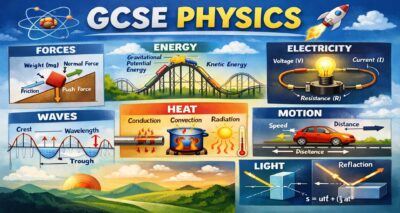
Just as an example below is an image created by ChatGPT for “GCSE Physics concepts explained visually”. It’s difficult to know where to start there are just so many errors.

  • Forces – just completely wrong – there’s nothing that is correctly labelled.
  • Energy is lame – it doesn’t explain anything.
  • Electricity is magic as there’s no power supply, but the bulb is lit.
  • Heat is vaguely correct(ish) but useless unless you already know what conduction, convection and radiation are.
  • Motion – nonsense; though I would like to know what Diseltance is.
  • Light – wrong on lots of different levels. What is reflaction? Why is there an incorrect version of one of the equations of motion? (It is interesting that ChatGPT has picked a common misspelling of reflection, proving it’s more Artificial than Intelligent).
 

ChatGPT terrible version of a summary of GCSE Physics


During our residential course we also have study skills sessions <link>. Although these are not subject specific their aim is to provide some tools for making revision easier and improving exam techniques.
 

Resources for GCSE Physics

  • Our collection of past papers and mark schemes


Exam board websites:

  • AQA
  • CCEA (Northern Ireland exam board)
  • Edxecel/Pearson
  • Eduqas/WJEC
  • OCR


We can, but very rarely do, CCEA GCSE Physics. We haven’t had any CCEA applications this decade.