
We started out in 1997 offering predominantly science revision, hence the name: Oxford Science Studies.
For the vast majority of GCSE students science is compulsory. Most schools offer students a choice of dual award, where Biology, Chemistry and Physics combine to count as two GCSEs; or a triple award, where the three sciences count as three separate GCSEs. Sometimes the triple award is referred to as single science – i.e. each science is a separate GCSE, though do note that AQA call their dual award offering “Trilogy”.
All our science tutors will be familiar with all distinctions and will pitch their sessions as appropriate, for example, 2nd year higher level triple award Physics, 1st year foundation dual award. On application you will provide this above detail, so that we can timetable students appropriately.
Roughly 1 million students sit GCSE Physics in one form or another each year.
We currently have more than 80 tutors offering this subject, many have decades of experience and all degree educated, keen to share their enthusiasm and insight.
Like all our courses, GCSE Physics revision courses are bespoke to the learner and designed to cater to their individual needs. All courses are student-led, with the students highlighting chosen topics in the first session, and tutors tailoring the learning to meet their needs through the appropriate learning style.
See our Student-led Revision Courses page for how this works in practice.
We cover all GCSE exam boards and differentiate between dual and triple award, first and second year of GCSE, as well as higher and foundation level exams.
For our bigger courses the physics GCSE often will be taught in small groups, typically 2-4 students, with a maximum of 6 students timetabled per class.
Although the content of all courses is student-led the tutors will also be aware of topics that they know students often get wrong or struggle with.
From a tutor and student point of view the student-led approach is a huge advantage. Focusing on problem areas is the most effective use of the limited time on a revision course and provides students with a relevant learning experience.
The vast majority of revision is typically done at home and for most GCSE students their GCSEs will be their first set of public exams. Hence, it will potentially be the first time that they have had to revise seriously and experience an exam hall setting, where the grades matter. For some, they may have revised or sat an exam before, say for the 11+ or school entrance exams, but for some this may a new step and for all this may be a major step up.
In the case of GCSEs we are here to help students learn how to revise, to speed up the revision process, and clarify troublesome topics.
In the long run all students need to learn the skill of revising on their own, but for GCSE some assistance can be very worthwhile and our tutors can provide some useful pointers (as well as our Study Skills sessions on Easter and Summer Courses).
For Physics (and Maths) practice is absolutely key – sitting down and solving physics problems is vital to becoming good at doing these types of exams. Just reading a physics textbook is not enough on its own. Whilst practice is essential for many subjects, for physics, maths, etc. where there is a “doing calculations” aspect to the exam, then practicing those calculations has to be a central element to any revision.
We are here to help students:
We can’t do the revision for them, but we can provide a structured learning environment and expert support. Many students do just revise for their physics GCSE at home, but having the support of a subject specialist, in a focused learning environment, may be more efficient.
There are some truly great (and free) resources out there; but you need to be careful in selecting your sources of learning. A big problem for GCSE Physics students (and any one really) is knowing how to differentiate between the great and the not so food. Parental guidance can help here – providing the parent or other adult has a reasonable grasp of physics.
The following are generally seen as relatively safe:
Things to avoid:
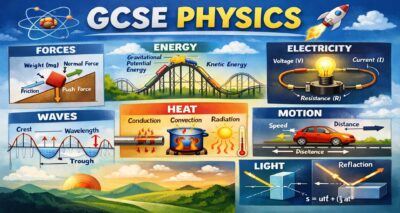
Just as an example below is an image created by ChatGPT for “GCSE Physics concepts explained visually”. Be wary, given the scope of errors here.
We can, but very rarely do, CCEA GCSE Physics. We haven’t had any CCEA applications this decade.